Last week, I looked at what I thought was the first Jaleco sports collection, featuring a pair of 8- and 16-bit soccer games from back in 1980s and 90s. As it turns out, the same people who just put out the Goal! compilation also released a similar set for Bases Loaded back in April. With no Nintendo Classics to talk about yet again, I wanted to take a trip back in time and cover those baseball games I missed a few months ago, including both Bases Loaded on the Nintendo Entertainment System, as well as Super Bases Loaded on the Super NES. Those are definitely Jaleco sports games, but are they actually worth playing? To answer that question, I decided to flip through the pages of Electronic Game Player, Video Games & Computer Entertainment, Super Play and more classic magazines that reviewed these games when they first came out. Get ready to round those bases and aim for the rafters, but not necessarily in that order, because it's time for another episode of Jaleco Sports Review Crew!
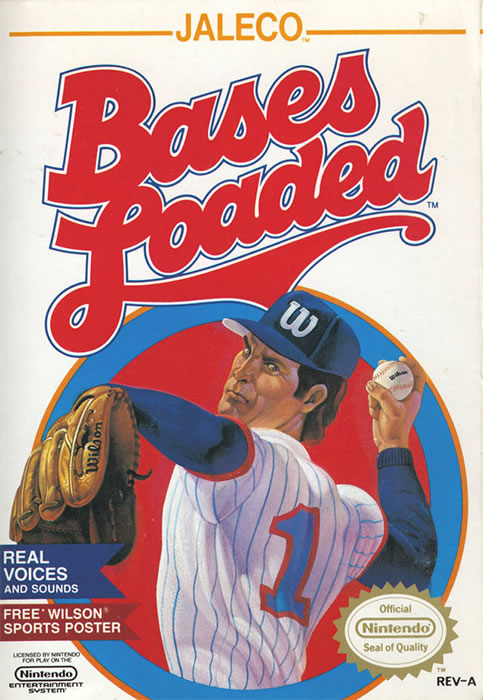
Bases Loaded
Nintendo Entertainment System
Jaleco
1988
Review Scores
| Publication |
Scores |
| Electronic Game Player |
Unscored (Yay) |
| Computer Gaming World |
Unscored (Nay) |
| AVERAGE SCORE |
N/A |
Bases Loaded came out at the perfect time. Released in 1988, it not only came out long enough after Nintendo's own Baseball game to look like a major update, but it also preceded a wave of high-profile competitors, like R.B.I. Baseball from Tengen and Major League Baseball from LJN. It was also eye-catching. Taking heavy inspiration from Hardball, Bases Loaded did a good job of recreating the pitcher's view that we're so used to seeing on the television. While still rudimentary, there was enough depth to the gameplay to keep the two-player matches interesting, and it looked substantially better than any of the prior baseball games on the Nintendo Entertainment System. But what did the critics say?
If you've watched me cover games released in the late 1980s, then you already know that it's sometimes hard to find reviews. That's definitely the case when it comes to Bases Loaded, a game released in July of 1988, a full year before Electronic Gaming Monthly hit the scene. But while we don't have EGM to look to, we do have the next best thing – Electronic Game Players. In case you aren't familiar, that was the magazine Steve Harris created right before Electronic Gaming Monthly. It only lasted four issues, but it did give us familiar features (like Gaming Gossip with Quartermann) and even shared some of the same writers. In fact, future EGM critic Ed Semrad concluded that, “overall, Bases Loaded is about as real as possible. While you can't choose your favorite teams, and you won't recognize any of the players by name, it does provide some of the most extensive play mechanics ever seen. If you're looking for a great baseball game with lifelike action and plenty of features, then Bases Loaded may be for you.” Unfortunately, Electronic Game Player didn't introduce a proper scoring system until issue 4, but I think it's safe to mark this one down as a positive review.
Speaking of scoreless reviews, that's also the case when it comes to Computer Gaming World, which reviewed Bases Loaded in its 54th issue. Right from the jump, the Game Doctor himself, Bill Kunkel, complained that sports games have been given short shrift on the Nintendo Entertainment System. He then laid out a litany of problems with Bases Loaded: “There's a tendency for fielders to begin running in random patterns once the ball is hit. There is also a pick-off play, but no real reason for one since there's no stealing. Most annoying, however, is the game's pretense at offering strategic options. Twelve teams are available, each containing non-existing players, most of whom have no statistics or ratings in any skill areas. So, there isn't a dime's worth of difference between then. The only thing that really matters is how fast and accurately the pitcher throws. This game is a mixed bag. It has attractive animation and good graphics combined with a very intensive hitter-pitcher simulation. However, the frustrations frequently threaten to overwhelm the virtues.”
Like I said, we don't get a proper score, but clearly this is a negative review. That means that one magazine liked it, while the other didn't. We may not have a lot of reviews to pull from, but at least we found balance. Give Bases Loaded a try. Maybe you'll like it ... or maybe you won't. Who knows?
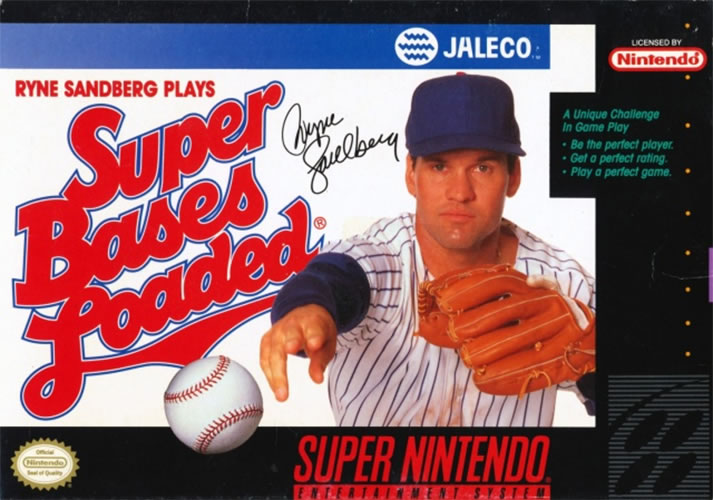
Super Bases Loaded
Super NES
Jaleco
1991
Review Scores
| Publication |
Scores |
| Game Zone |
92% |
| N-Force |
85% |
| Raze |
84% |
| ACE |
790/1000 |
| Game Informer |
7.2/10 |
| Video Games & Computer Entertainment |
7/10 |
| Games-X |
3/5 |
| Nintendo Power |
3/5 |
| Super Play |
55% |
| AVERAGE SCORE |
73% |
What a difference a few years makes. When we looked at Bases Loaded on the Nintendo Entertainment System, the best I could dig up was two unscored reviews. Now, three years later, and there are almost too many reviews for the first Super NES entry – Super Bases Loaded. For those keeping track, this is technically the fifth installment in the Bases Loaded franchise, which means that Jaleco has had a whole lot of time to refine their system. What's more, the 16-bit hardware should, in theory, help the developers created a more realistic baseball simulator. But will that translate to strong reviews?
The answer to that question is a resounding ... YES! And also, no. Maybe? When it comes to Super Bases Loaded, the scores were all over the place. With so many magazines to choose from, and such a range of scores to get through, I'm just going to start in the middle – Video Games & Computer Entertainment. Giving the game a 7 out of 10, Mike Davila concluded that “as a gamer, I found Super Bases Loaded a lot of fun to play, but as a critic, I felt that so much more could have been done to make it a complete baseball experience. On the other hand, if you're looking for a hard-hitting, clear-cut baseball game, then Super Bases Loaded is for you.”
When we look at the lower scores, you see Games-X give the sports game their patented triple-X rating, which is the same 3 out of 5 score we saw from Nintendo Power. Believe it or not, it's actually Super Play who went the lowest, giving Super Bases Loaded a low 55%, making it their 463rd best-reviewed Super NES game. “Super Bases Loaded's most noteworthy feature – and its downfall – is the way battle takes place from the pitcher's point of view. This makes it incredibly difficult to judge the best time to swing at the ball and, although you do eventually get used to it, it never really looks quite right. Scruff and slow, with a strange way of doing thing.”
Now, that's one side of the scale, but remember when I said that the reviews were all over the place? I meant it. As we begin our climb back up the scale, we see Game Informer give the game a 7.2 out of 10 in only their second issue. ACE liked it a bit more, giving it a score of 790 out of 1,000. “Compared to the likes of F-Zero or Final Fight, this doesn't astonish technically, but gameplay wise, it's fine. The graphics have a slightly rough-and-ready half-finished look to them, but they do their job. It's a real shame more wasn't made of the home run celebration screens. The cheesy tunes provide a suitable ballpark atmosphere.”
If you're looking for even high scores, then Raze clocked in with a fantastic 84%, while N-Force went one tick higher, giving the sports game an 85%. And then there's Game Zone, who took a break from bashing some of your favorite games in order to give Super Bases Loaded a high score of 92%. “All in all, there is enough variety here to keep even the most avid baseball fan happy, especially in two player mode, where you can challenge a chum to battle it out on the plates. ‘But surely,' I hear you cry, ‘there must be a fault somewhere!' And I guess there is. Like all sports games, when you play the computer, you are up against a real toughie. But that is a midgey little complaint when you think how boring it would be if you beat it on your first outing. Super Professional Baseball is a pretty amazingly good game. A stronger argument for Nintendo releasing the Famicom in the UK, I could not think of. It's brill-o. Beg, borrow and steal a Famicom to play this game. And just think, if it had been available a couple of thousand years ago, there would still be a herds of Barse roaming our hills, gonads intact.”
You know, I could try to explain the Barse reference at the end, but it's better out of context. Honestly, it's great seeing this variety of opinions. There are some valid complaints being leveled against the game, yet it seems like a lot of those problems go away if you're playing with a friend. With scores ranging from 55% all the way up to 92%, the overall average is a solid 73%. I'm excited to see how that stacks up to the 16-bit sequel, and can't wait for the next Jaleco collection. Keep them coming!